
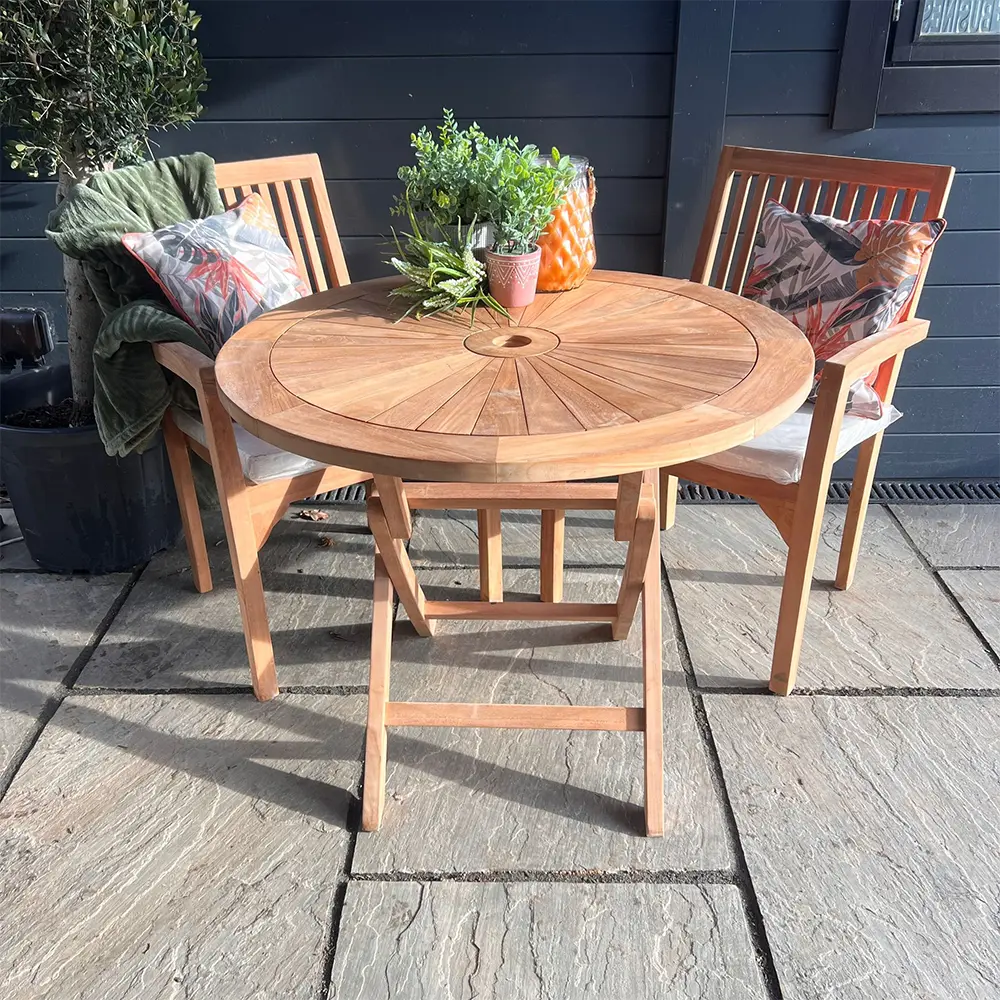
Most teak garden furniture is designed with sprawling patios in mind, and most advice simply lists products without ever telling you what actually fits. If your outdoor space is a compact courtyard, a modest terrace or the patio behind a terraced house, that leaves you guessing, and guessing usually ends one of two ways: 1) a set that swamps the space or 2) a set too small to enjoy when there are more than just two people.
This guide fixes that. Below you will find real minimum dimensions for every common teak configuration, from a two-seat bistro set right up to an eight-seater extending dining set, a simple three-step method for measuring your patio, and layout ideas for the garden shapes people actually have. And here is the surprise many owners discover once they measure properly: small gardens may have more space available than you think. With the right configuration, a space you assumed was bistro-only can seat six in comfort.
First, measure your patio properly
Almost every furniture mistake starts with a measurement mistake. Our buying guide to choosing a teak dining set sets out the comfortable standard: allow 90cm of clearance between the table and any wall, fence or fixed obstacle, and prove it with the masking tape test, mapping the set plus its clearances out on the ground before you buy.
That 90cm standard is the right starting point. But in a small garden, applying it to all four sides costs you space you do not need to give up. The refined version for compact spaces works like this:
- Measure the usable rectangle, not the whole garden. Ignore the lawn, the beds and the borders. Measure the paved or decked area where furniture will actually sit, and subtract anything fixed within it: planters, a water butt, the arc of a door that opens outwards.
- Apply clearance where it earns its keep. Keep the full 90cm anywhere people walk behind seated guests. Where someone only needs to sit down and stand up, 75cm is enough. And a side that sits flush against a wall, a bench most obviously, needs no clearance at all.
- Reserve one walkway, not four. Keep at least 60cm clear along one side so you can move around the set, and 90cm if that side is the route to a gate, shed or washing line.
Run the masking tape test with those numbers and write down the result as a simple width-by-depth figure, such as 3m x 2m. Every recommendation in this guide keys off that number.
Which teak set fits your space
Under 3 square metres: the bistro set
A teak bistro set, one round or square table of 60 to 80cm with two chairs, occupies roughly 1.2m x 1.2m of space and lives happily on a 1.5m x 1.5m patio. It is the right answer for balconies, courtyard corners and the classic morning-coffee spot. Choose folding chairs, and the whole set clears away against a wall in seconds. Our two-seater teak dining sets are built around exactly this footprint.
3 to 6 square metres: the folding four-seater
A 90 to 110cm square or round table with four folding chairs needs a minimum of about 2.5m x 2.5m to be used comfortably. This is the workhorse configuration for small gardens: everyday meals for a household of four, with the flexibility to fold two chairs away and free the floor when it is just the two of you. The teak folding dining sets range covers every version of this layout, including flat-fold tables that store just 10 to 15cm deep.
Narrow spaces and boundary walls: the bench and table set
Where the patio is long but shallow, a bench with a rectangular table in front of it beats four chairs every time, for one simple reason: a bench needs no pull-out clearance. You slide along it rather than dragging it back, so the 75cm a chair demands behind it disappears. A straight-backed bench pushes tight to a wall to save the most depth of all, while curved-back designs stand slightly off it but still claim back most of the space. A 2.5m x 2m patio runs this layout comfortably. One check before you buy: make sure the bench’s seat height pairs with your table, since some garden benches are designed as standalone seating rather than dining seating. The seat height is listed on every product page in our teak garden benches range.
6 to 9 square metres: the six-seater
Here is where measuring properly pays off. A rectangular six-seater, a 150 to 180cm table with six chairs, needs around 3.3m x 2.7m as a minimum, and many gardens that feel small, clear that bar once the tape measure comes out. Browse the full range of teak garden dining sets seating from two to twelve.
9 square metres and up: eight-seaters and extending sets
A full eight-seater teak dining set, or an extending table opened to its maximum, needs at least 4.5m x 3m. If that sounds beyond a small garden, hold that thought until the extending table section below, because there is a way to own this capacity without living with its footprint.
The dimensions reference table
Match the usable rectangle you measured earlier against the minimum column. If you clear the comfortable column, size up with confidence.
| Set type | Typical furniture footprint | Minimum patio space | Comfortable patio space |
| Bistro set (2 seats) | 1.2m x 1.2m | 1.5m x 1.5m (2.25 sq m) | 2m x 2m |
| Folding 4-seater | 1.8m x 1.8m | 2.5m x 2.5m (6.25 sq m) | 3m x 3m |
| Bench and table set (4 to 6 seats) | 2m x 1.5m, bench flush to a wall | 2.5m x 2m (5 sq m) | 3m x 2.5m |
| 6-seater rectangular set | 2.2m x 1.8m with chairs tucked in | 3.3m x 2.7m (8.9 sq m) | 4m x 3m |
| Extending table, closed (seats 6) | 2m x 1.8m | 3.3m x 2.7m (8.9 sq m) | 4m x 3m |
| 8-seater or extending set, fully open | 3m x 1.8m | 4.5m x 3m (13.5 sq m) | 5m x 3.5m |
You probably have more room than you think
The 90cm rule exists because it is always comfortable. But comfortable-everywhere is not the same as necessary-everywhere, and most people under-buy garden furniture because they apply it to sides that do not need it. These four points could make all the difference when it comes to making the smart choice for your new teak dining set:
- Allowing pull-out clearance on every side. Clearance follows the seating, not the table. Allow roughly 75cm behind any chair so it can be pulled out, and the full 90cm where people also walk behind seated guests. A side with no seating on it, a table edge against a wall, or the wall side of a straight-backed bench, needs no clearance at all.
- Forgetting the bench advantage. A bench needs no pull-out clearance, and a straight-backed one sits tight to a wall as well, reclaiming 10 to 15cm of depth compared with chairs on the same side. That is often the difference between a four-seat and a six-seat layout.
- Counting the walkway twice. You need one clear route around or past the set, not clearance on all four sides.
- Measuring the garden instead of the patio. The lawn was never going to hold the table. Measure the hard surface and work with the real number.
Run your measurements again with those corrections, and a 3m x 3m patio, which feels like four-seater territory, will often take a six-seat bench-and-table layout with the walkway intact.
Folding or stacking chairs?
Every retailer sells both. Almost nobody explains the difference in the terms that matter, which are storage footprints.
Four folding teak chairs store flat against a wall or fence in a strip roughly 10 to 15cm deep. Four stacking chairs need a floor patch of about 60cm square, plus the height of the stack, which in practice means a shed, a garage corner or a spot you are willing to look at all winter.
The rule is straightforward. If you have no dedicated storage, choose folding. If you have a shed or covered corner and you move chairs in and out often, stacking is quicker to deploy and slightly sturdier in daily use, since there are no hinges in play. Both styles are available across our teak garden chairs range.
Bench or chairs?
On the space arithmetic, the bench wins narrow patios outright: no pull-out clearance needed, a straight-backed design sitting tight to the wall to save 10 to 15cm of depth, and higher capacity per metre since three children fit where two adult chairs would go. Chairs win on flexibility, because they move to wherever the sun is and pull up to other seating when friends come round.
A simple rule: if the narrowest dimension of your patio is under 2.5m, put a bench on the wall side and chairs opposite. Above 2.5m, choose whichever suits how you live.
Round or rectangular table?
Shape matters more than most buyers expect. A round table has no corners to catch hips and clothing, so it clears walkways on square or tight patios and lets people squeeze past on all sides. A rectangular table uses a narrow space far more efficiently, running along the long axis with seating down each side.
The decision rule: patio roughly square, go round. Patio long and narrow, go rectangular and align it with the longest wall. Every shape, in fixed, folding and extending styles, is covered in our teak garden tables range.
The extending table: small footprint, big occasions
If one configuration resolves the small-space, big-family dilemma, it is this one. A teak extending table sits closed at around 150 to 200cm for everyday use, seating four to six in the footprint of a standard set, then opens to 210cm or more and seats eight when the occasion demands it. You live with the small footprint and own the large capacity. Our extendable teak dining sets are designed so the extending mechanism is part of the table itself. Check the product page for how each model’s mechanism stores when closed.
Two practical notes. First, check the open length against your patio before buying, using the table above, because the extended position still needs its clearances on the day. Second, pair it with folding chairs for the extra seats, so the occasional capacity does not create a permanent storage problem.
Layout ideas for four real patios
2m x 2m: the courtyard corner
A bistro set placed diagonally in the corner furthest from the door, both chairs folding. The diagonal placement keeps the walking line from the door clear and makes the space read larger than a set squared up against the wall would.
3m x 2m: the narrow terrace
A straight-backed bench tight against the long wall with a rectangular table in front, two folding chairs on the far side.This seats four to six with a full 60cm walkway preserved along the open edge, in a space most buyers would have written off as bistro-only.
4m x 3m: the standard small patio
A rectangular six-seater aligned with the 4m wall, leaving a 90cm walkway on the house side. Alternatively, an extending table in its closed position, which frees another half metre day to day and still hosts eight at a push. Either way, this footprint comfortably outgrows the four-seater most owners assume it is limited to.
The L-shaped garden
Treat the two arms as two rooms. Dining goes in the larger arm, sized from the reference table, and the smaller arm takes a bistro set or a single bench as a separate quiet spot. Keep the junction of the L completely clear, because it is the pinch point every route passes through.
No shed? No problem: teak lives outside
Seasonal storage is the section every small-garden guide skips, presumably because the honest answer removes the problem. Quality teak is dense and naturally rich in oils, and it is built to stay outdoors all year round, untreated, through frost, rain and everything a UK winter offers. There is nothing to bring in, nothing to wrap and nothing to treat.
Left alone, teak weathers from its original golden brown to an elegant silver-grey tone whilst remaining completely sound structurally. Some owners prefer to keep the golden tone by oiling, and that is purely an aesthetic preference rather than anything we would recommend; the furniture does not need it. A wipe-down in spring and an occasional brush to clear pollen is the entire care routine, which is precisely the advantage you want when there is no shed to store anything in.
Frequently asked questions
What size teak furniture fits a small patio?
Match the set to your measured space: a bistro set fits in a space from 1.5m x 1.5m, a folding four-seater from 2.5m x 2.5m and a six-seater rectangular set from 3.3m x 2.7m. Measure the usable paved area, keep a 60cm walkway clear, and buy to the space you actually have.
Are folding or stacking teak chairs better for small gardens?
Folding, if you have no storage: four folded chairs stand against a wall in a strip just 10 to 15cm deep. Four stacked chairs need around 60cm square of floor plus their stacked height, so stacking only makes sense where a shed or covered corner exists.
Should I choose a teak bench or chairs?
Choose a bench where space is tight. It needs no pull-out clearance, and a straight-backed bench sits tight to a wall, together saving 10 to 15cm of depth compared with chairs. Check the seat height suits your table, as some benches are standalone seating. Under 2.5m of depth, the bench wins.
Can teak garden furniture stay outside all year?
Yes. Teak is dense and naturally oil-rich, so quality teak furniture lives outdoors year-round in the UK with no cover, no treatment and no winter storage. It gradually weathers to a silver grey while staying structurally sound, which makes it ideal for gardens with no shed.
Is a round or rectangular table better for a small garden?
Round for square patios: no corners mean clear walkways on every side. Rectangular for narrow patios, aligned with the longest wall, because it seats more people per square metre of floor. Match the table shape to the patio shape, and the space works harder.
Can a six-seater fit in a small garden?
Often, yes. A rectangular six-seater needs about 3.3m x 2.7m with standard clearances, and a small garden can shrink that further: a straight-backed bench against a wall needs no clearance behind it. Measure first, because the answer is smaller than most owners expect.
Does teak garden furniture need oiling?
No. Teak needs no oil, sealant or treatment to survive outdoors, and untreated teak stays structurally sound for decades. Oiling is purely an aesthetic choice for owners who prefer the original golden tone over the natural silver-grey that weathered teak develops.