
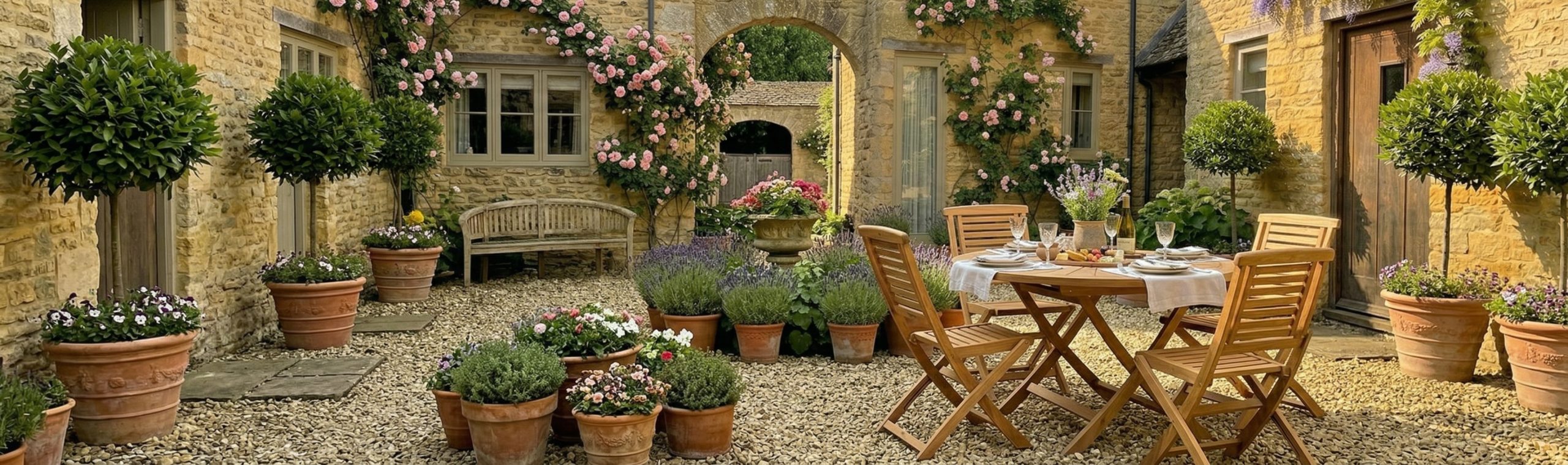
If you have been comparing teak and acacia garden furniture, you have probably noticed something odd about the advice you’ll read online. In our experience, much of the advice you’ll read is produced for an American or Australian audience, with prices in dollars and warnings about relentless sun. That is not much use when your furniture will spend its life in a British garden, where the real challenges are damp air, wet winters, frost and long stretches where the patio never fully dries out.
This guide specifically compares teak and acacia for UK conditions. It covers how each wood copes with a wet British winter, why acacia quality varies so much from one retailer to the next, what each wood really costs over a decade, and what piece of hardwood garden furniture suits which material. All of the prices we reference are in pounds.
The short answer
Teak is the stronger all-round choice for a UK garden. Its natural oils allow it to live outside all year, through rain and frost, with nothing more than an occasional clean. Acacia costs less upfront but is more vulnerable to prolonged damp, and it generally needs covering or storing through the British winter. If you want furniture you can leave out and largely forget about, choose teak. If your budget is tight and you are happy to protect the furniture through winter, acacia can work. The rest of this guide explains our rationale.
How each wood handles a British garden
Teak in UK conditions
Teak is unusually well suited to British weather (being a teak garden furniture specialist, you would expect us to say this), but the explanation is genuine, and the reason is simple – it’s the wood itself. Teak contains a high level of natural oils and rubber within its grain. Those oils repel water, resist rot and deter insects without any coating or sealant. The wood is also dimensionally stable, meaning it does not swell, shrink or warp significantly as moisture levels rise and fall, which matters a great deal in a climate where furniture can be soaked one week and dry the next. In an environment where we can see four seasons in one day (even in summer), your choice of garden furniture needs to reflect this reality.
In practice, this means a teak dining set can stay on the patio through a British winter. Rain, frost and even snow do not compromise the structure of the wood. The colour changes over time, moving from golden honey to silver grey tone, but this is a surface change rather than a sign of deterioration. Many owners consider the silvered look one of teak’s best features, particularly in cottage and country garden settings.
Acacia in UK conditions
Acacia is a genuine hardwood and outdoor material, but it does not carry the same natural defences as teak. Its oil content is lower, so it relies more heavily on the finish applied at the factory and on how well the owner protects it afterwards.
The British problem for acacia is not one dramatic storm. It is the slow, persistent damp of October through to March. When acacia sits wet for extended periods, the wood can absorb moisture, which leads to swelling, surface checking (fine cracks along the grain) and, in poorly ventilated spots, mould and mildew on the surface. None of this happens overnight, and a well-made acacia set that is covered and stored sensibly can give good service. But it asks more of you than teak does, and buyers weighing up the pros and cons of Acacia vs. Teak should go in with their eyes open.
The damp problem, explained
From our research, many comparison guides frame outdoor durability in terms of sun exposure because they are written for hotter climates. In the UK, ultraviolet fading is a minor issue compared with moisture. A British garden bench can be damp for weeks at a time in winter, and it is that sustained moisture, not heat, that separates the two woods.
Teak’s oils mean water beads and run off rather than soaking in. Acacia, with less natural oil, gradually takes moisture on board when its finish wears. That single difference explains most of what follows in this guide: the lifespan gap, the maintenance gap and the price gap.
Understanding the materials
What teak actually is
Teak is a dense tropical hardwood prized for centuries in shipbuilding and outdoor joinery, precisely because it survives constant exposure to water. The qualities that made it the standard for boat decks, natural water resistance, stability and strength, are exactly the qualities you want in furniture that lives outdoors in Britain.
Why “acacia” is not one wood
Here is something almost no comparison guide tells you: acacia is not a single timber. In practice, ‘acacia’ furniture is usually made from fast-grown plantation species such as Acacia mangium or the related Acacia auriculiformis, while denser, more expensive timbers like Acacia melanoxylon (Australian blackwood) sit at the premium end, so two sets both labelled simply ‘acacia’ can be very different woods.” It is a label covering hundreds of related species, and they vary widely in density, oil content and durability. The acacia used in a premium piece may be a dense, tight-grained timber that performs well outdoors. The acacia in a budget flat-pack set may be a faster-growing, lighter species that struggles after a couple of British winters.
This is why acacia reviews online can be so contradictory. One owner could report their set lasting for years; another says theirs cracked in eighteen months. Both reviews could be based on truth and factually correct; the different experiences could be because they are talking about completely different types of wood. Teak, by contrast, is far more consistent from one piece to the next, which is part of what you are paying for.
How to judge hardwood quality before you buy
Whichever wood you are considering, the same practical checks apply:
- Weight and build. Within a given wood, heavier and more substantial is usually the better buy: a quality hardwood table should feel solid, not hollow or flimsy. The clearest signal is the thickness of the tabletop, and it is worth checking the spec rather than the photo, because tabletop thickness varies more than you might expect. For Kingsley Smythe, thickness varies from around 2.5cm on lighter designs up to 4cm on heavier-built tables such as the 150cm Titan, which pairs a 4cm top with solid 10cm legs.
- Grain. Look for tight, even grain. Wide, open grain suggests faster-grown timber that may be less stable outdoors.
- Finish. Surfaces should be smooth and consistent, with no rough patches, filler or hairline splits, particularly at the ends of boards where moisture enters first.
These checks matter twice over with acacia, because of the species variability above. With teak, they help you separate the well-made from the merely adequate.
Durability, lifespan and the real 10-year cost
How long each wood lasts
Teak garden furniture is a long-term purchase in the truest sense. Looked after with nothing more than occasional cleaning, a quality teak set will serve for decades, and it is common for teak furniture to be passed down rather than replaced. Acacia’s realistic horizon in a UK garden is shorter and depends heavily on care: protected and stored well, a good acacia set can last around a decade; left exposed year-round, its working life shortens considerably.
The arithmetic nobody does
The upfront price gap between the two woods is real, and it is the reason acacia sells so well. But the upfront price is not the full cost. Over ten years, an acacia owner will typically buy covers, care products and, in many cases, a replacement set, while a teak owner buys a cover if they choose to and otherwise spends almost nothing.
10-year cost comparison (indicative UK prices, 2026)
| Cost over 10 years | Teak (6-seat dining set) | Acacia (6-seat dining set) |
| Purchase price | £1,120 to £2,500 | £400 to £900 |
| Protective cover | £50 to £120 (optional) | £50 to £120 (strongly advised) |
| Care and cleaning products | £20 to £40 | £100 to £200 |
| Replacement within 10 years | Not expected | Often once (£400 to £900) |
| Realistic 10-year total | £1,190 to £2,660 | £950 to £2,120 |
The numbers are indicative and worth checking against current retail prices, but the pattern holds: the gap between the two woods narrows dramatically once the full decade is counted, and a teak set finishes those ten years with most of its life still ahead of it, while an acacia set is typically at or near the end of its own.
Maintenance: what each wood asks of you
Teak: clean it, then leave it alone
Teak’s maintenance routine is refreshingly short. Wash it down once or twice a year with warm water and mild soap, using a stiff brush or nylon pad rather than a wire one, to lift off any tree and bird deposits. That is essentially it. If you do choose to pressure wash, keep it to the lowest setting, hold the nozzle well back and work along the grain rather than against it, since water at close range can lift the grain permanently.
You will read elsewhere that teak should be oiled to keep its golden colour. Kingsley Smythe treats oiling as an optional choice rather than a necessity and does not recommend it as protection. Teak oils and treatments are not absorbed into the wood; they sit on the surface purely as a colourant, fade over the season, and add nothing to strength or lifespan. Left alone, teak weathers gracefully to an even silver grey, which is the wood’s natural outdoor state and one many owners actively prefer. That weathering is purely cosmetic. With teak, in other words, the low-maintenance option is, by default, the right option.
One thing worth knowing before you reach for a tin of oil or a pressure washer: with Kingsley Smythe’s furniture, both can affect your warranty. Applying any oil, sealant or treatment within the first year voids the warranty, and pressure washing is done at your own risk, because the wrong product, or the right one applied badly, can damage the wood in ways the manufacturer cannot be responsible for. It is one more reason the simplest routine, a soapy wash and letting the wood age naturally, is also the safest. Full guidance is on the Kingsley Smythe teak aftercare page.
Acacia: a wood that needs an owner
Acacia asks for a more active relationship. A sensible care routine for a British garden looks like this:
- Clean regularly. Warm soapy water and a soft brush, especially after wet spells, to keep mould and mildew from establishing on the surface.
- Follow the manufacturer’s care guidance. Acacia is usually sold with a factory finish, and most acacia manufacturers specify a routine for maintaining it. Whatever that routine is, it needs doing; a worn finish is where moisture problems begin.
- Cover it in wet weather. Use a breathable cover, never a plastic tarpaulin, which traps condensation underneath and creates exactly the damp conditions you are trying to avoid.
- Lift it off wet ground. Acacia legs standing in puddles or on saturated grass draw moisture up into the end grain. Hard standing or furniture feet make a real difference.
Winter storage
Through a British winter, teak can simply stay where it is; a breathable cover keeps it cleaner but is a convenience rather than a necessity. Acacia should ideally come under cover from late autumn: a garage, shed or well-ventilated corner under a breathable cover. Cushions for either wood should always come indoors over winter. Kingsley Smythe’s accessories range includes fitted weatherproof cushions and covers designed for exactly this.
Which furniture should be made of which wood
The all-or-nothing verdict most guides give, teak good, acacia bad, misses a useful nuance: the right wood partly depends on what the furniture is and how it is used.
Dining tables and dining sets
This is where Teak’s case is strongest. A dining table is the largest, most-used and most permanent piece in the garden, and the one you least want to be dragging into a shed every November. Teak’s ability to live outside year-round, combined with its stability under a table’s weight and span, makes it the natural choice. Kingsley Smythe’s teak garden dining sets run from compact six-seaters through eight-seat and ten-seat sets for bigger gatherings, and for anyone whose guest numbers change through the year, extending teak sets keep the table compact day to day and open it up for parties. For a data-led look at which configurations UK buyers actually choose, see what UK buyers are actually choosing in teak garden furniture.
Chairs and occasional seating
Chairs move, stack and store more easily than tables, which softens acacia’s storage burden somewhat. Acacia side chairs, paired with careful winter storage, can be a workable budget route. That said, mixed-material sets rarely age evenly, and a teak table with acacia chairs will look mismatched within a few seasons as the two woods weather differently. If storage space is the concern rather than budget, teak folding sets solve the same problem without the maintenance trade-off, folding flat to as little as 10 to 15cm deep.
Benches and loungers
Benches are usually the most exposed pieces in a garden, often sitting on grass or soft ground away from the house, and frequently forgotten in winter. That exposure profile strongly favours teak. Loungers sit low, close to damp ground, and are handled and moved often, which again rewards teak’s stability and its tolerance of being left out.
If you want zero maintenance at all
For buyers whose priority is genuinely no upkeep whatsoever, it is worth knowing a third option exists. Kingsley Smythe’s Plasteak range offers the look of weathered teak in a synthetic material that needs nothing beyond a wipe-down. It is not wood, and it does not pretend to be, but for exposed coastal gardens or second homes, it is an honest alternative to both timbers.
UK price guide
The table below sets out typical UK retail ranges as of mid-2026. Prices vary by size, design and retailer, so treat these as an orientation rather than a quotation.
| Furniture type | Acacia, typical UK price | Teak, typical UK price |
| 4-seat dining set | £250 to £600 | £800 to £1,600 |
| 6-seat dining set | £400 to £900 | £1,200 to £2,500 |
| 8-seat dining set | £600 to £1,200 | £1,800 to £3,500 |
| Garden bench (2 to 3 seats) | £100 to £300 | £350 to £900 |
| Sun lounger | £150 to £350 | £450 to £1,000 |
Two things stand out. First, teak’s premium is consistent at roughly two and a half to three times acacia’s price for equivalent pieces. Second, when that premium is read against the 10-year cost table earlier in this guide, much of it comes back through longevity: the acacia set that costs a third as much may also need replacing within the period, while the teak set is only getting started.
Buying directly from a manufacturer rather than through garden centres or department stores also shifts these numbers meaningfully. Kingsley Smythe manufactures and imports its own teak dining sets, which is why its pricing sits toward the accessible end of the teak ranges above.
Aesthetics – how each wood looks, and how it ages
New, the two woods are not dissimilar: both show warm golden-brown tones, with acacia often slightly darker and more varied in its figuring. The difference emerges with time outdoors.
Teak weathers evenly. The whole piece moves together from honey gold to silver grey, and the result reads as intentional: the driftwood-toned furniture you see in coastal and country gardens across Britain. Acacia weathers less predictably. Because its protection depends on an applied finish, wear shows first where the finish fails: armrests, table edges, seat fronts. The result after a few seasons can be patchy rather than uniform, which is why acacia rewards owners who keep up with its care routine.
On sustainability, both woods are grown commercially rather than taken from wild forests, and responsible retailers can document where their timber comes from. Kingsley Smythe’s furniture is V-Legal certified, with wood from documented legal sources, and through its Trees4Trees partnership, two trees are planted for every teak dining set sold. Buyers for whom sourcing matters should simply ask any retailer what documentation sits behind their timber.
The verdict, by buyer type
The budget buyer. If the upfront number is the deciding factor, Acacia gets you eating outside this summer for a few hundred pounds. Go in knowing the care routine is not optional in a British climate, budget for a breathable cover from day one, and store it well over winter.
The longevity buyer. Teak, without hesitation. It is the only choice here that can genuinely be described as buy once. A quality set such as those in the Kingsley Smythe teak dining range will outlast the patio it stands on.
The low-maintenance buyer. Teak again, and specifically teak left to weather naturally. No oiling, no annual rituals, just an occasional wash. If even that sounds like too much, the Plasteak range removes maintenance from the equation entirely.
The undecided buyer. If you are torn, let the furniture type decide. Tables, benches and anything that lives permanently outside: teak. Occasional pieces you are happy to store each winter: acacia is defensible. And if you are furnishing in stages, start with a teak table as the anchor and build around it.
Frequently asked questions
Is teak or acacia better for UK gardens?
Teak is better suited to UK conditions. Its natural oils resist the damp, frost and prolonged wet spells typical of British weather, so it can stay outside all year with minimal care. Acacia costs less but needs covering, regular care and ideally winter storage to last in a wet climate.
How long does acacia garden furniture last in the UK?
With good care, covering in wet weather and storage over winter, quality acacia furniture can last around a decade in a UK garden. Left uncovered and exposed year-round, its lifespan shortens considerably, with swelling, surface cracks and mould the most common problems.
Can acacia garden furniture stay outside in winter?
It is not recommended in the UK. Prolonged winter damp causes acacia to absorb moisture, leading to swelling, cracking and mildew. Ideally, store it in a shed or garage from late autumn, or, at a minimum, raise it off wet ground and use a breathable cover, never a plastic sheet.
Is teak garden furniture worth the extra cost?
For most UK buyers, yes. Teak costs more upfront but lasts for decades with almost no maintenance, while cheaper woods often need replacing within ten years. Counted over its full lifetime, teak is frequently the cheaper option per year of use, not the more expensive one.
Does teak go grey, and can you stop it?
Yes, teak left outdoors naturally weathers from golden honey to an even silver grey. This is purely cosmetic and does not affect strength or lifespan. Kingsley Smythe does not recommend oiling teak; the wood protects itself, and the silvered finish is its natural outdoor state.