
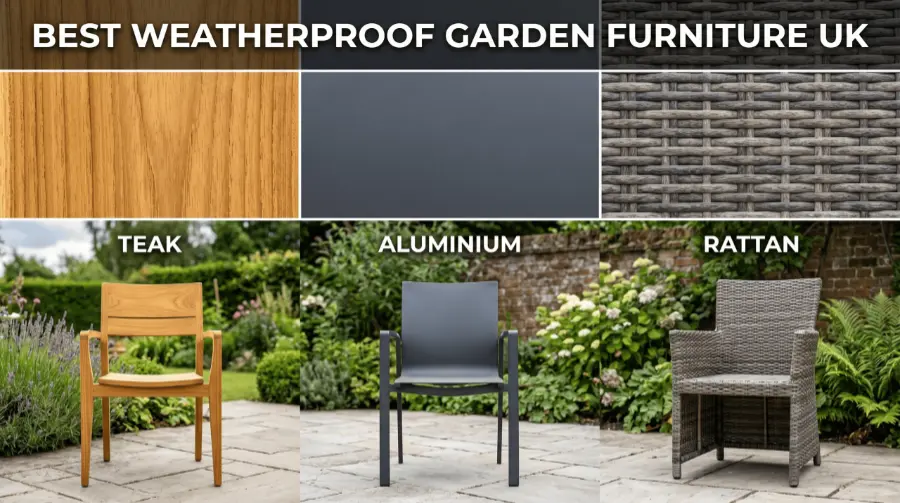
If you’re researching weatherproof garden furniture, you’ve probably encountered three materials recommended repeatedly: teak, powder-coated aluminium, and synthetic rattan. We sell teak. That’s worth knowing upfront. But the reason we sell teak, and only teak, is the same reason we’re confident writing this comparison: nothing else comes close over the long term.
This article covers how all three materials perform in British conditions, what the real cost of ownership looks like, and why buyers who have done the research keep arriving at the same conclusion.
What “Weatherproof” Actually Means for a UK Garden
Garden furniture marketed as weatherproof is often tested under conditions that don’t reflect what a British garden actually delivers year-round.
The UK averages around 1,154mm of rainfall per year, spread across all twelve months rather than concentrated in a wet season. Winters bring freeze-thaw cycles, particularly in the north and Midlands, where water absorbed into porous materials expands and contracts repeatedly, working on joints, surfaces, and frames. UV exposure is lower than in southern Europe but consistent enough over summer to fade and degrade weaker materials. Coastal gardens add salt air, which accelerates surface wear on metal frames that aren’t perfectly sealed.
A material that’s genuinely weatherproof for UK conditions needs to handle all of this without requiring significant seasonal intervention. Teak does. The bar for the alternatives is higher than their marketing suggests.
How Each Material Actually Performs
Teak
Teak is a dense tropical hardwood (Tectona grandis) harvested from managed plantations, primarily in Indonesia. It has been the material of choice for outdoor and marine applications for centuries, not because of marketing, but because of two inherent physical properties: a very tight grain that severely limits water absorption, and a high natural oil content that repels moisture from within the wood itself.
In freeze-thaw terms, this matters more than any other single property. Wood expands when it absorbs water and contracts as it dries. Repeat that cycle through a British winter and softer, more porous materials crack, split, and degrade at joints. Teak absorbs minimal water to begin with. The expansion-contraction cycle is negligible. The Janka hardness rating, the timber industry standard test for resistance to denting and wear, puts teak at 1,155 lbf, harder than oak and in a different category entirely to the softwoods used in most budget garden furniture.
Left untreated, teak weathers from its warm golden-brown to a silver-grey patina over the first year or two outdoors. This is surface oxidation only and is cosmetic, not structural. The furniture is no weaker for it. Many buyers find the silver tone more naturally suited to a garden setting than the fresh golden colour. Either way, the wood itself is unchanged.
Expected lifespan: 50 years plus with minimal care. This is not a marketing claim; park benches made from teak have been in continuous outdoor use for close to a century. It is the only common garden furniture material where a 50-year lifespan is a realistic expectation rather than a best-case scenario.
Teak requires no annual treatment, no seasonal storage, no cushion management, and no specialist cleaning. Warm water, a brush, and a couple of hours a year. That’s the full maintenance requirement.
Powder-Coated Aluminium
Aluminium doesn’t rust; it contains almost no iron. Powder coating adds a hard finish that handles UV and rain reasonably well. On paper, it’s a sound outdoor material. In practice, the performance ceiling is considerably lower than teak’s.
Powder coat chips. On cheaper aluminium garden furniture, which accounts for most of what’s available at mid-market price points, the coating chips at corners, joints, and contact points within a few years. Once the seal breaks, the frame corrodes from that point inward. Quality aluminium frames from premium manufacturers hold up longer, but the manufacturing standards in this category vary enormously, and a buyer cannot easily assess frame quality at the point of purchase.
Aluminium also dents. A hardwood like teak does not. For furniture that will see regular outdoor use over many years, dent resistance matters more than it might seem at the time of buying.
The more significant practical issue is cushions. Aluminium furniture is uncomfortable without them. That means cushion storage, cushion replacement (typically needed at year 8–10 on quality sets), and the year-round reality of either bringing cushions in overnight or buying weatherproof cushion fabrics at significant additional cost. Teak seating is comfortable without cushions by design. That is not a minor convenience difference; it is a genuine daily-use difference over the life of the furniture.
Expected lifespan: 15–25 years on a quality frame, less on budget sets. The cushions will need replacing at least once within that period.
Synthetic Rattan (Poly Rattan)
Synthetic rattan covers an enormous range of products united primarily by aesthetics rather than performance. At one end: polyethylene weave over a steel frame, visibly degrading within three to five years in UK conditions. At the other: UV-stabilised HDPE weave over a powder-coated aluminium frame, holding up significantly better. The problem is that these products look similar at point of purchase and are sold side by side across a wide price range.
The weave structure that makes rattan appealing, softer, warmer, more casual than teak or aluminium, is also its weathering weak point. HDPE weave on quality sets resists fading and brittleness for 10–15 years. But the weave traps debris: leaves, pollen, dirt, bird deposits accumulate in the gaps in a way that flat teak surfaces simply don’t. In a UK garden with trees overhead, this is a real maintenance consideration.
Rattan is also entirely cushion-dependent for comfort. The same storage and replacement cycle applies as with aluminium, and because rattan furniture is typically configured for lounging rather than dining, the cushion area per set is larger and the replacement cost correspondingly higher.
Expected lifespan: 5–25 years, depending almost entirely on grade. This variance makes it the hardest category to commit to at any price point, as you are buying a brand’s reputation more than an objectively assessable material.
Side-by-Side
| Teak | Aluminium | Synthetic Rattan | |
| Weather resistance | Excellent | Good–Excellent | Moderate–Good |
| UK freeze-thaw resistance | Excellent | Good | Moderate |
| Coastal salt air | Excellent | Good (quality frames) | Moderate |
| Cushions required | No | Yes | Yes |
| Annual maintenance | Wash down | Wash down + cushion care | Wash down + cushion care |
| Expected lifespan | 50+ years | 15–25 years | 5–25 years |
| Comfortable without cushions | Yes | No | No |
| Resale value | Yes | Minimal | No |
| Entry price (6-seater dining) | £1,200–£3,000+ | £500–£2,000+ | £300–£2,000+ |
The Real Cost of Ownership
Purchase price is the wrong number to use when comparing furniture that lasts five years against furniture that lasts fifty.
Here are three comparable scenarios: a 6-seater dining set from each category at a quality level where all three are genuinely suitable for UK outdoor use.
Teak dining set: £1,800
Annual maintenance: a wash down twice a year. No treatment required. No cushions. No covers needed.
Cost at year 10: £1,800 Cost at year 20: £1,800 Cost at year 50: £1,800
At the end of that period, the furniture retains resale value. A teak dining set in good condition is a secondhand market asset. It does not go in a skip.
Quality aluminium dining set: £900
Annual maintenance: breathable cover for winter storage (£60–80, lasting a few years). Cushion replacement at year 8–10 (£150–300 depending on spec, replacing again at year 18–20).
Cost at year 10: approximately £1,100 Cost at year 20: approximately £1,500 Cost at year 25: set likely retired or significantly degraded
At retirement, resale value is negligible.
Quality synthetic rattan set: £800
Annual maintenance: covers, cushion replacement at year 6–8. Weave degradation begins showing at 12–15 years on quality sets.
Cost at year 10: approximately £1,050 Cost at year 15: approximately £1,300 — set approaching end of useful life
At retirement, resale value is zero. A replacement cycle begins.
Teak costs more on the day. Over a decade, the gap narrows significantly when cushions, covers, and replacement cycles are included. Over twenty years, teak is the cheaper option. Over fifty years, it is not a comparison worth making.
The numbers also don’t capture what isn’t measurable: teak improves as it ages. The silver-grey patina that develops over the first couple of years is considered by many buyers to be more attractive than the original golden tone. Aluminium and rattan simply wear. There is no version of a fifteen-year-old rattan sofa set that looks better than when it was new.
Why Buyers Choose Teak
The buyers who choose teak are not paying for a material advantage they’ll never notice. They’re paying to make a decision once. One purchase, in one afternoon, that they will not need to revisit, replace, or reconsider for the rest of the time they live in that house.
That is what teak actually is. It’s the option that removes garden furniture from the list of things you need to think about. It sits outside all year. It handles everything British weather produces. It gets better-looking with age. And when the time eventually comes to move house, it goes with you or it sells.
For a garden you’re serious about, there’s only one sensible answer.
Frequently Asked Questions
What is the best garden furniture to leave outside all year in the UK?
Teak. Its natural oil content and tight grain give it resistance to moisture, freeze-thaw cycles, UV, and salt air that no other common garden furniture material matches over time. It requires no seasonal storage, no treatment, and no annual maintenance beyond a wash down. Aluminium and quality rattan can also be left out year-round, but neither matches teak’s durability or longevity over the full lifespan of the furniture.
What is the most durable outdoor furniture available in the UK?
Teak, by a significant margin when measured by lifespan. A quality teak dining set bought today will still be in use in 50 years. The same cannot be said of aluminium or synthetic rattan at any price point. Teak park benches have been in continuous outdoor use for close to a century in some cases. The material’s track record over time is unmatched.
Is teak garden furniture worth the higher price?
Yes – when measured correctly. The upfront cost of teak is higher than aluminium or rattan, but when cushion costs, replacement cycles, and actual lifespan are factored in, teak is the cheaper option over 20 years and dramatically cheaper over 50. It also retains resale value, which no other common garden furniture material does. The question is not whether teak is expensive, it’s whether you’d rather buy once or several times.
What garden furniture won’t rust?
Teak (wood doesn’t rust, and its natural oils prevent the rot that is wood’s equivalent), quality powder-coated aluminium (no iron content), and synthetic rattan over aluminium frames. Avoid: steel frames without premium rust-resistant treatment, natural rattan, and softwood furniture. Of the rust-free options, only teak combines zero-rust risk with a 50-year lifespan and no cushion dependency.
Does weatherproof garden furniture need covering?
Teak does not need covering, structurally or aesthetically, it handles year-round outdoor exposure without protection. A breathable cover can reduce cleaning time by keeping debris off the surface, but it is entirely optional. Aluminium and rattan furniture, by contrast, requires covers for cushion protection and to extend the life of the finish. For teak, covering is a convenience. For everything else, it’s closer to a necessity.